







Scientists have developed an intelligent camera system designed to keep bears away from areas where their presence could create problems for people. The technology uses artificial intelligence to recognise approaching bears and automatically release a deterrent when an animal enters its detection range. The system was field tested for 30 days and the researchers reported 3 successful deterrence events. The study examines how automated detection and rapid response could provide a practical way to reduce unwanted bear encounters without people having to intervene directly.
How does the AI-powered camera system detect and deter bears
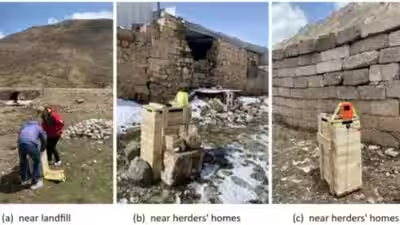
The system was developed to mitigate human–bear conflicts in the Tibetan Plateau, where encounters can threaten local livelihoods and the survival of the Tibetan brown bear . They designed it to work in remote locations that may not have access to conventional electricity and internet connections.The technology combines computer vision with Internet of Things hardware, a study published in the journal Ursus on 8 April 2026 said. Its main components are a low power AI board, a detection system that uses a camera and a solar powered bear spray device.The idea is to recognise a bear as it approaches and activate the deterrent automatically. This allows the system to respond without waiting for a person to notice the animal or operate the equipment.
The technology is suitable for remote locations
A major consideration in the design was its ability to operate in remote areas. Remote communities may lack reliable electricity or network access. Conventional monitoring and deterrence equipment can be difficult to operate continuously .The researchers developed a low-power system that does not depend on an internet connection. Solar power supplies the energy needed to operate the deterrent, while the artificial intelligence hardware processes visual information locally. By allowing the equipment to operate independently, the technology could potentially be installed in locations where regular human supervision is difficult.
How accurately could the system recognise approaching bears
For the technology to work safely, it needed to distinguish bears from other animals, people and everyday objects. The researchers addressed this by developing an image collection containing 1,243 wildlife and other visual samples.The collection included 795 bear images, of which 100 were captured using infrared cameras to help the system recognise bears in low-light conditions. It also contained images of mastiffs, yaks, humans and vehicles, allowing the researchers to train the technology to identify bears among other common sights.The team used 80% of the images to train the detection model and reserved the remaining 20% for validation. The system was built around a YOLOv5-MobileNet model, which was deployed on a low-power AI board.According to the study, the model achieved a mean average precision of 91.4% and a recall rate of 93.6% during validation. These results indicated that it could identify bears with a high level of accuracy while detecting most of the bears present in the test images.
What happened during the controlled activation tests
Before taking the equipment into the field, the researchers conducted 100 controlled activation tests. These involved simulated approaches by bears, humans and other animals to examine whether the system could recognise the intended target and respond appropriately.Results showed that the spray mechanism was activated within 0.2 sec of target detection with 97.2% accuracy. This quick response was crucial since an approaching bear may not give people much time to react, especially in remote areas. The tests also determined whether the system could avoid triggering when something other than a bear was in its detection range.
The 30-day field trial recorded three successful deterrence events
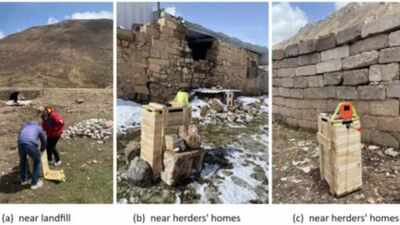
The researchers then took the technology out of the lab and tested it in the real world. The experiment was conducted for 30 days in Zadoi County, Qinghai Province, China. During that time the system logged 3 successful bear deterrence events. Significantly, the researchers reported no false activations during the trial.Three successful events hints that the system holds promise, but the short trial period points to the need for more testing to see how consistently the system works over a longer time and in different conditions.The researchers designed the system with two objectives in mind: reducing the risks associated with human–bear encounters and supporting the conservation of Tibetan brown bears.