






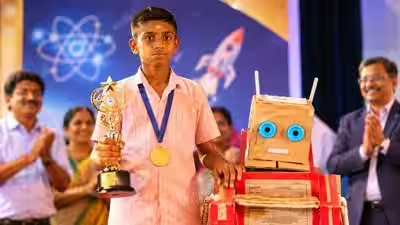
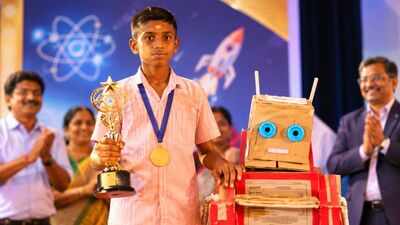
A cardboard box that might have ended up in a dustbin, a few PVC pipes and some discarded electronic components became the building blocks of an award-winning science project for a Class 9 student from Tamil Nadu. Lokasurya, a student of Anaiyur Government High School near Sivakasi, has drawn national recognition for creating a low-cost, remote-controlled multipurpose robot from materials that are often thrown away.His creation did not involve expensive equipment or sophisticated laboratory facilities. Instead, it demonstrated how an everyday problem, a little technical understanding and the willingness to experiment can come together to produce something useful. The young student received the National Young Scientist Award in a competition organised by Space Kidz India, bringing recognition to his school and his science teacher, who guided him through the project.
A robot with a purpose, not just a moving machine
Lokasurya’s project was designed around a simple idea: could a robot made from inexpensive, easily available materials perform a useful task inside a school? The answer took shape as a multipurpose robot that can be operated remotely. According to reports by ‘Dinamani’ and ‘Dinamalar’, the model was assembled using cardboard boxes, PVC pipes, LED lights and small electronic components. Rather than relying on costly robotics equipment, the student used materials that could otherwise have been discarded.The robot was designed to help teachers carry stationery and other writing materials inside classrooms. This practical purpose gave the project an everyday application, making it more than just a demonstration of a machine that could move when controlled. There was also an environmental message behind the invention. By turning discarded materials into a functional model, Lokasurya wanted to highlight the possibilities of reuse and recycling. The project brought together two ideas that are increasingly important in science education: finding affordable solutions and making better use of available resources.
The teacher who helped turn an idea into an invention
Behind the student’s achievement was the guidance of his schoolteacher, Karunaidhas. He mentored Lokasurya during the development of the project and helped him prepare the model for the national-level competition.Building a working robot requires more than collecting materials. Different components need to be brought together so that the model can perform its intended function. The combination of a remote-control mechanism, electronic components and a practical design meant that the project needed careful development.The robot went through multiple stages of evaluation before reaching the final round, according to the reports. Its selection reflects the importance of demonstrating how an idea can work, rather than presenting it only as a concept.For students who do not have access to expensive equipment, projects like this also offer an important reminder: scientific exploration can begin with materials available in their immediate surroundings. A classroom, a teacher’s guidance and the willingness to experiment can provide a starting point for learning how technology works.
From a school project to national recognition
Lokasurya’s invention earned recognition at a national-level Young Indian Scientist competition organised by Space Kidz India in Chennai. After progressing through several rounds of evaluation, his multipurpose robot was selected for the National Young Scientist Award. The award ceremony became another memorable moment in the student’s journey. Group Captain Angad Pratap, an astronaut-designate selected for India’s Gaganyaan human spaceflight programme, presented him with the Young Scientist trophy.The achievement also brought appreciation from the education department and the school community. Lokasurya and his mentor, Karunaidhas, were congratulated by education officials, the school headmaster and fellow teachers and students. The school’s in-charge headmaster, Ramasubramanian, shared details of the achievement, as reported by ‘Dinamani’. The recognition was particularly meaningful because the project came from a government school in Anaiyur, near Sivakasi, and was built using relatively inexpensive materials.
Why this small robot carries a bigger lesson
What makes Lokasurya’s achievement interesting is not simply that a teenager built a robot. It is the way he approached the process of invention. Robotics is often associated with specialised laboratories, expensive kits and advanced technology. His project offers a different perspective by showing how students can begin exploring engineering concepts with accessible materials and practical ideas.It also connects science lessons to problems that children can observe around them. Moving stationery across a classroom might seem like a small task, but finding a way to automate it involves thinking about movement, control, electronics and design.Equally important is the project’s message about waste. Materials that are usually thrown away can sometimes become useful resources when someone looks at them differently. This approach encourages children to think beyond buying new things and consider how existing materials can be reused creatively. Lokasurya’s journey is a reminder that innovation does not always begin with a sophisticated machine or a big investment. Sometimes, it starts with a cardboard box, a few electronic components and a student curious enough to ask what else they could become.