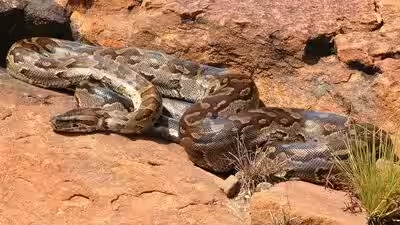




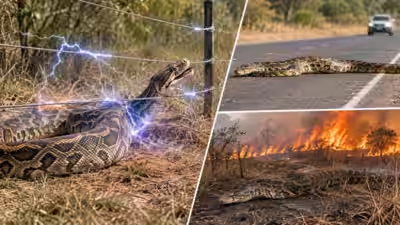
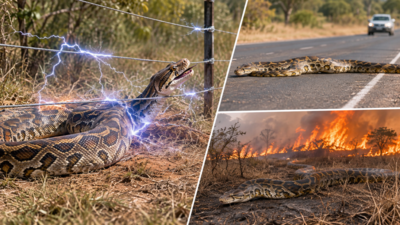
Southern African pythons can become trapped and electrocuted beneath electric fences after swallowing large prey. The researchers found evidence of two pythons killed this way. Kirsty J. Kyle and Colleen T. Downs compiled 1,237 locality records from South Africa, covering 1907 to 2025, and documented further threats to the snakes. According to a study in the African Journal of Ecology, titled ‘Protected and Yet Pressured: Persistence of Southern African Pythons (Python natalensis) in South Africa Despite Changing Land Use and Other Anthropogenic Threats,’ they recorded road deaths, including 30 incidents reported on iNaturalist between 2013 and 2025, and four pythons killed in fires. The authors also propose measures such as adjusting fences, timing management burns and adding road signage to reduce the deaths.
Why Southern African pythons get trapped beneath electric fences
According to Kyle and Downs, the researchers compiled 1,237 locality records for southern African pythons in South Africa, covering 1907 to 2025. Of these, 432 dated from before 2015 and 805 from 2015 onwards. The authors write that the species’ overall range did not change much between the two periods, but the number of known localities within that range increased. They add that this is likely a symptom of citizen science and greater access to reporting platforms rather than evidence that the species is actually increasing or expanding.The species has been listed as “Least Concern” on the IUCN Red List since 2019. However, according to Kyle and Downs, citing Alexander and Tolley (2021), many populations are known to be declining, with some local extinctions in the Eastern Cape and KwaZulu-Natal provinces, while in other areas the snakes appear to be expanding their range. The authors report that 661 of the 1,237 records, or 53%, came from protected areas, which cover 9.2% of South Africa’s mainland surface area. They say the snakes’ large body size makes them particularly vulnerable to anthropogenic threats.
Why roads pose a major threat to Southern African pythons
According to Kyle and Downs, the researchers found evidence of two southern African pythons killed by electric fences. They also found several accounts in popular articles of pythons “rescued” from such fences, along with numerous anecdotal reports describing the fences as a serious problem for large-bodied pythons, especially after the snakes had swallowed large prey. The authors note that the IUCN assessment (Tolley et al. 2023) and a 2009 study (Beck 2009) both recognise electric fences as a threat to the species.The authors explain why swallowed prey matters. Pythons swallow their prey whole, and it is frequently large, which leaves the snake with a greatly distended body. According to the paper, a python without this feeding bulge can use familiar routes and slide under electric fences without being shocked. After ingesting a large prey item, however, it can become stuck under the fence. The wire then pins the snake down; it cannot escape, and it is electrocuted. Kyle and Downs add that the documented number of fence deaths is small, but this information was recorded casually and informally.
How winter fires threaten Southern African pythons
According to Kyle and Downs, roads are a major threat to southern African pythons. The authors write that the snakes’ long bodies and generally slow movement make them particularly vulnerable to vehicles, and that their tendency to move at night makes them less visible to drivers. The researchers drew on several sources for road mortality data. A search of iNaturalist revealed 30 incidents of pythons killed on roads between 2013 and 2025, spanning five southern African countries and five provinces within South Africa.The paper reports that a further 61 individuals were recorded as roadkill in the Endangered Wildlife Trust’s traffic report (Leeuwner and Hlatshwayo 2025). A roadkill survey in iSimangaliso Wetland Park recorded nine pythons over three years (Cormac et al. 2025). To reduce these deaths, Kyle and Downs suggest road signage and driver awareness measures, particularly in areas with high python densities or known roadkill hotspots. They also say speeds could be reduced further in likely crossing areas, and that signs warning travellers they might encounter wildlife, including snakes, would be beneficial in high-risk areas.
Researchers propose protecting Southern African pythons from human threats
According to Kyle and Downs, fire is another threat made worse by human activity. Through literature searches and personal communications, the authors found evidence of four pythons killed by fires: one in a wildfire and three in management burns. Two of the pythons were found together in a single management fire. The paper states that most fires occur in late winter, when snakes are generally slow-moving and spend time basking because of the lower temperatures. The authors say literature indicates that pythons also congregate for breeding at this time, which could result in several snakes being killed in one burning event, as happened in Tembe Elephant Park (Jordaan and Steyl 2022).For fires, the authors propose timing management burns to avoid the periods when snakes are most vulnerable. They say pythons appear to congregate for breeding from June to the beginning of October, depending on the area. They note that breeding is often associated with burrows, but cite Jordaan and Steyl (2022) as suggesting that smoke inhalation and flames cause significant damage, so underground refuges may not be as effective as hoped. For fences, they suggest adjusting them to let pythons pass underneath, setting the bottom wire as a return or ground wire that carries no current, or reducing the time between pulses so a snake can feel the first shock and retreat. They state that these changes could potentially also reduce deaths in other species with a similar vulnerability, such as tortoises and pangolins (Lee et al. 2021), and recommend future research to monitor how effective the measures are.