








HYDERABAD: The hostel dorms at the Birla Institute of Technology and Science (BITS), Pilani, Hyderabad, have thrown up yet another startup that has caught the attention of the Army.
The startup is working to enhance the device’s power and antenna options based on Army feedback.
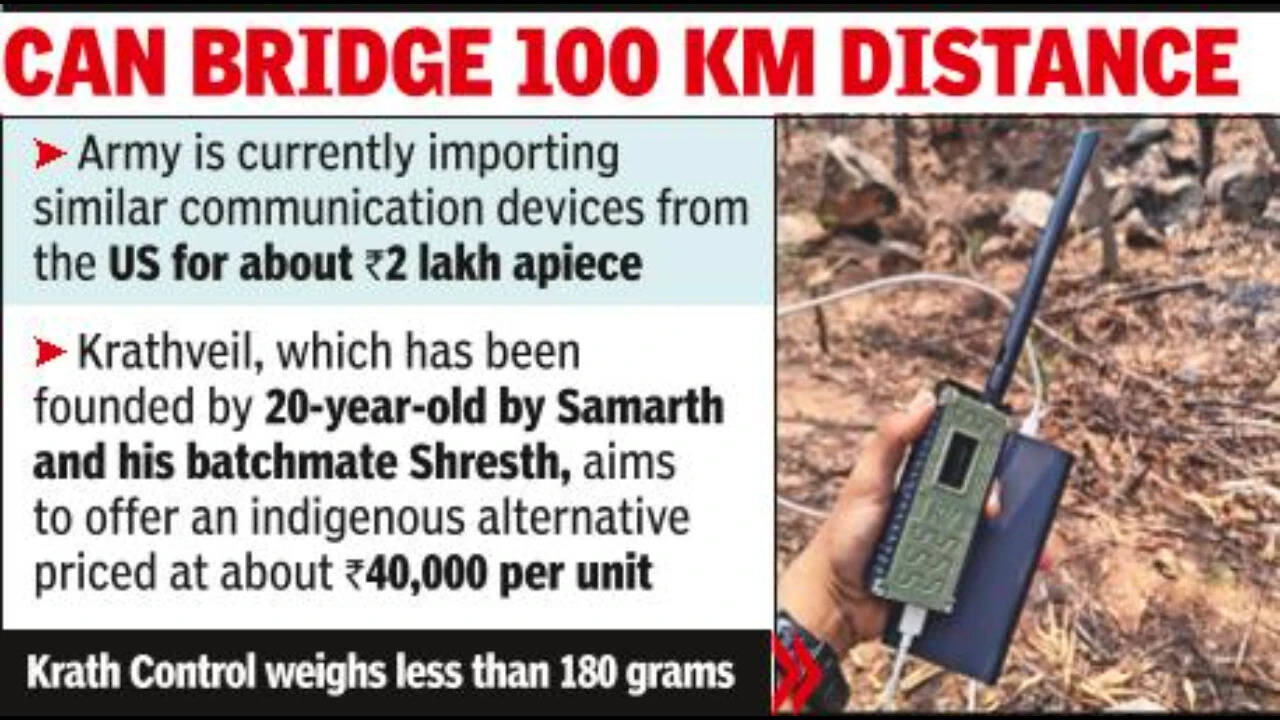
After the student venture Apollyon Dynamics built drones for the defence forces, another student-led startup, Krathveil, is now developing a communication network for soldiers through pocket-sized radios that could help them stay connected even in areas which do not have mobile towers or even satellite links.The Army is currently said to be importing similar devices from the US at around Rs 2 lakh apiece. Krathveil, founded by 20-year-old BITS student Samarth Alok Srivastava and his batchmate Shresth Prakash Singh, aims to offer an indigenous alternative priced at Rs 40,000 per unit.Pocket radio promises 100-km connectivity without towers | page 2Samarth, who earlier interned with Apollyon Dynamics, incorporated Krathveil in May. Shresth joined him as co-founder in July and took charge of the startup’s technology operations.Through their startup, the duo, both third-year dual-degree students and natives of Thane, have developed Krath Control — a pocket radio weighing less than 180 grams. The device pairs with a soldier’s phone and connects with other nearby radios through an encrypted mesh network.“Conventional voice radios allow soldiers to communicate but do not show their locations. Imported systems that offer live mapping capabilities cost several times more and are not optimised for Indian terrain. They are also closed systems, making integration with existing infrastructure difficult. We are addressing these gaps with Krath Control,” Samarth said.The mesh radios, the founders said, can potentially bridge distances of more than 100 km without relying on communication towers, satellites or even SIM cards. Each radio connects to nearby devices, forming an encrypted network. Even if one radio or node drops out, the network automatically finds an alternate route to keep communication running.“It puts the entire section on a single live map for almost the same price as a voice radio. On paper, a single hop between two hilltops can cover more than 100 km, and we are taking this to the field next,” he said. The device was recently assessed by two units of the Indian Army for its ability to provide infrastructure-independent voice and data communication, along with situational awareness. “We were asked to increase its power output and use better antennas. We had a limited budget, so we used a low power output of 156 milliwatts, which they want us to increase to 1 watt. Similarly, the antennas we initially used need to be upgraded,” said the 20-year-old.Recognised by the DPIIT, the startup is looking to secure incubation at the PIEDS. It aims to develop an upgraded version incorporating Army’s suggestions over next two to three months, following which it plans to submit device for another assessment. “We assessed Krathveil’s mesh for infrastructure-independent communication at the sub-unit level. Today we meet that need with an imported commercial system, and there has been no Indian alternative. Krathveil’s is a promising one. It is encouraging to see a young team take this on, and we would welcome a user assessment as system matures,” said an Army official from Ranchi.


